
HPDE.app: The Sovereign Motorsport Pace Index (MPI) Clearinghouse & 120+ Circuit Intelligence Hub
Engineered as the neutral, cross-sanction central hub of our motorsport ecosystem (`hpde.app`, `hpdelicense.app`, `hpdelicensed.app`), HPDE.app solves amateur motorsport’s universal licensing vacuum. Just as scuba diving relies on PADI and golf relies on the USGA GHIN handicap, the Motorsport Pace Index (MPI) establishes a 5-tier driver accreditation standard (Levels 1.0 to 5.0) mapped across NASA, PCA, SCCA, BMW CCA, and independent track clubs—backed by a 120+ North American road-course engineering database and a decoupled stint-telemetry vault (`mpi-vault-sync.js`).
Engineered on Next.js App Router + React 19 Sovereign Hub Architecture, MPI v1.0 Cross-Sanction Governance & 5-Axis Evaluation Engine, 120+ Circuit Geospatial, Sound-Limit & Tire-Bias Database with full build-time HTML prerendering, interactive domain tools, and Layer A / Layer B code ownership.
Engineered & Operated for Real-World Production
Because competing track clubs will never hand their customer lists to a rival event organizer, a universal licensing authority must be architected as a strictly neutral, zero-PII-leakage clearinghouse. It requires a formal 5-tier competency specification, a cross-sanction run-group equivalency matrix, a non-blocking local-first API (`https://hpde.app/api/vault/sync-stint`) that ingests driver stint telemetry without touching operator financial records, and deep circuit-specific engineering parameters across 120+ road courses.
Inside the Live Application, Calculators & Before/After Transformation
Captured directly from the production build and legacy comparison—inspect the real interface, engineering calculators, and operational portals below. Click any screenshot to enlarge.
HPDE.app as the Neutral Central Hub Connecting All Motorsport Spokes
Explore how HPDE.app serves as the central credentialing and circuit-intelligence hub while federating with our operator and driver-wallet spokes.
Maintains the national 5-tier Motorsport Pace Index (MPI) specification, the 120+ road-course engineering database, and the sovereign driver stint vault.
HPDE.app — National Motorsport Pace Index (MPI) Clearinghouse & 120+ Circuit Hub
The neutral cross-sanction licensing standard and road-course engineering database.
DriveHPDE.com — Full 6-Portal Track Day, Cockpit HUD & Paddock Telemetry Platform
Our flagship 195+ file track-day event, registration, In-Car Cockpit HUD, thermodynamic tire PSI calculator, and live Paddock TV platform.
TrackDayOS.app & RaceDayOS.app — $0 Per-Ticket Event Engine, Race Control Tower & Paddock TV
Multi-tenant white-label operating system for track day organizers and circuits with sub-200ms Race Control Tower flag dispatch.
HPDEPassport.com & HPDECertified.app — 15-Second QR Gate Pass, Digital Self-Tech & Insurance Dossiers
Driver-owned credentialing and mechanical safety verification spoke powering Apple/Google Wallet QR gate passes and underwriter PDF packets.
The Commercial & Technical Challenge
Amateur sports car track days suffer from complete institutional fragmentation. Hundreds of independent clubs, regional car marque chapters, and private track operators hoard driver evaluations in paper logbooks or incompatible spreadsheets. An experienced driver with 35 verified solo track days at Watkins Glen, VIR, and Road Atlanta is routinely forced to register as a Novice and pay for mandatory in-car instruction when visiting a new organization—while Chief Instructors have zero verifiable data to vet out-of-region signups.
How GreenTree Engineered the Platform
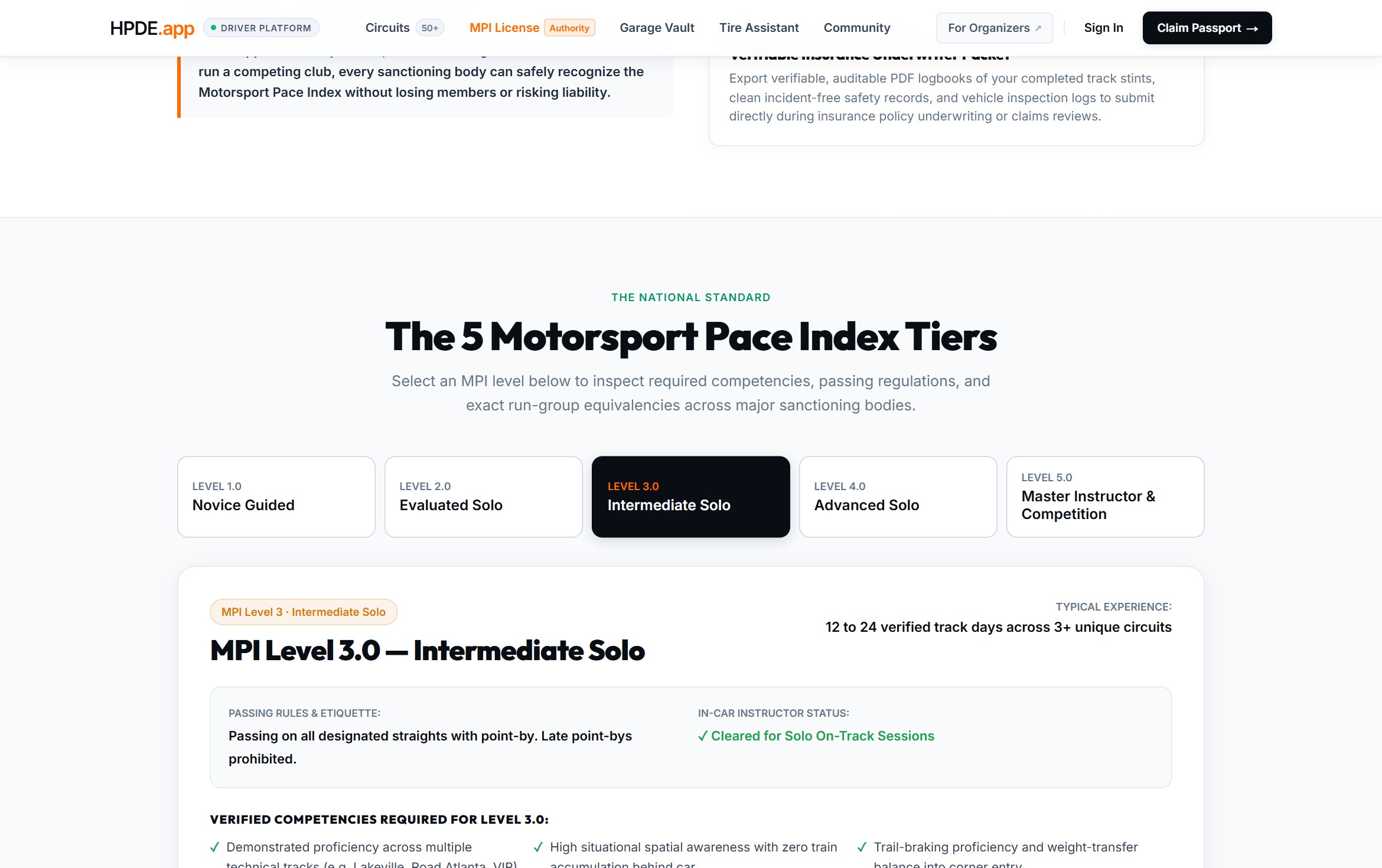
- 5-Tier Motorsport Pace Index (MPI) National Governance Standard (`mpi-framework.js`) defining verifiable competency checklists, passing rules, instructor requirements, and cross-sanction equivalencies from Level 1.0 Novice Guided through Level 5.0 Master Instructor & Competition.
- 5-Axis Weighted Chief Instructor Evaluation Rubric scoring drivers across Line Choice & Apex Precision (25%), Braking & Weight Transfer (25%), Traffic Management & Mirrors (20%), Lap-Time Consistency (15%), and Safety & Flag Discipline (15%).
- Decoupled, Non-Blocking Sovereign Vault Sync Protocol (`mpi-vault-sync.js`) enabling operator spokes like DriveHPDE.com and TrackDayOS.app to push stint tire pressures, 3-zone pyrometer readings, fuel burn, and solo sign-offs into the driver’s HPDE.app vault with offline localStorage retry queueing.
- 120+ North American Road-Course Intelligence Database (`tracksDatabase.js`) indexing circuit coordinates, elevation change, braking severity index (1–10), curb aggressiveness, decibel sound limits, corner-by-corner tire thermal bias, and reference lap benchmarks (911 GT3 RS, C8 Z06, BMW M2, Spec Miata).
Interactive Calculators, Portals & Engines Built Into This Platform
Allows drivers and Chief Instructors to inspect required competencies, passing rules, and exact run-group mappings across NASA HPDE, PCA DE, SCCA Track Night, BMW CCA, and independent clubs.
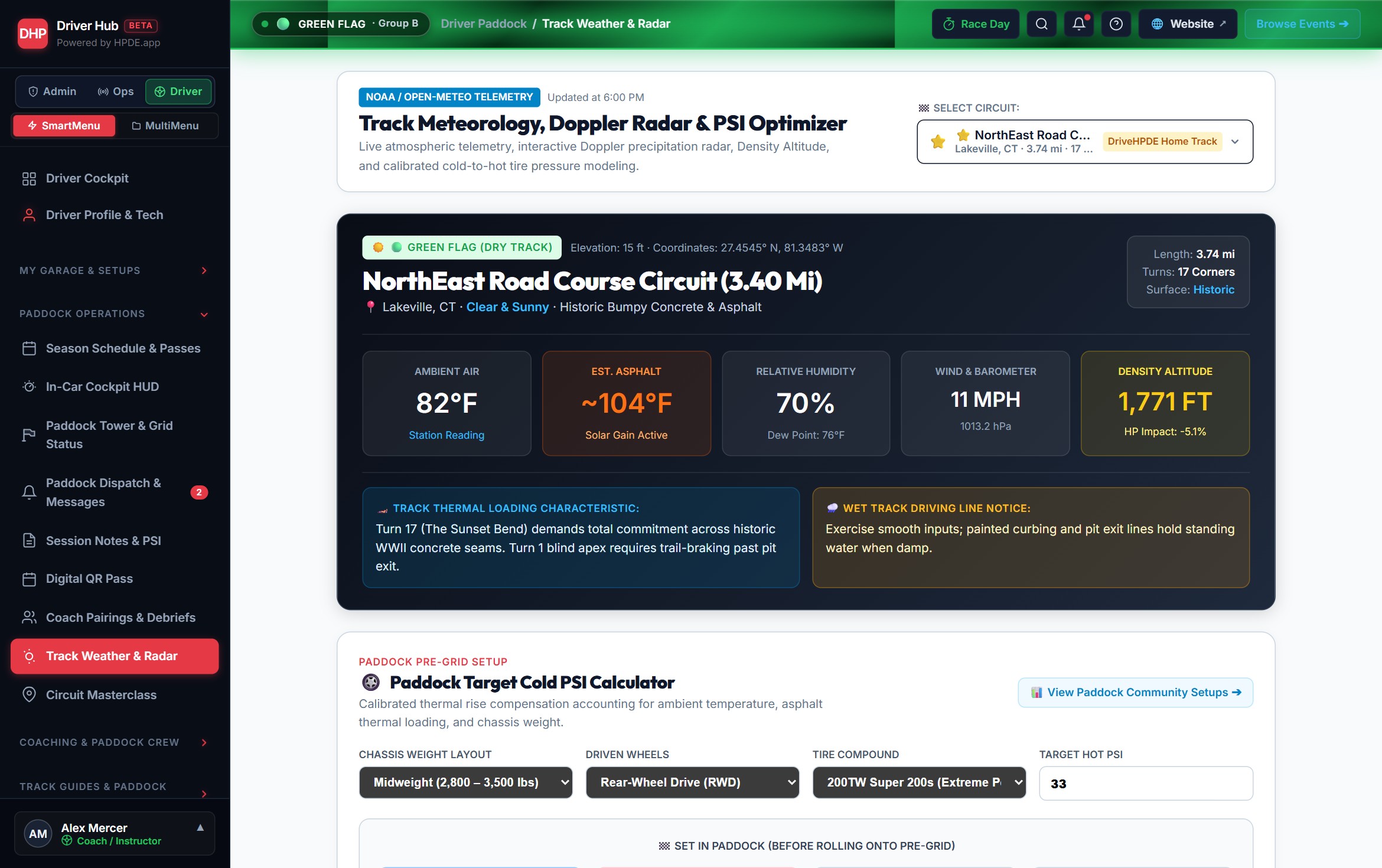
Searchable regional directory detailing track length, turn counts, sound curfews (e.g., 103 dB at 50ft), high-stress tire corners, cold PSI adjustments, and chassis lap-time benchmarks.
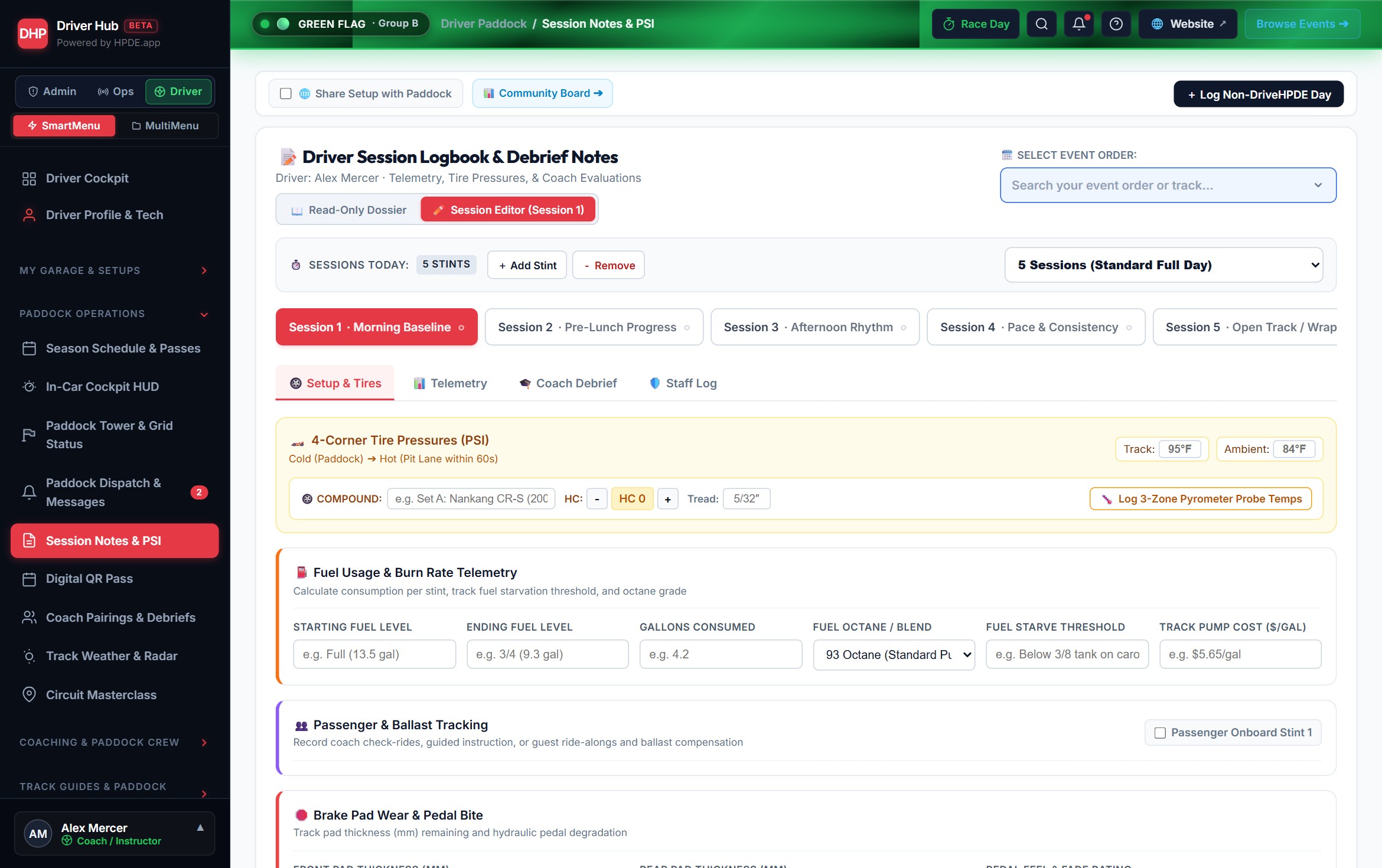
Local-first synchronization engine that queues stint logbooks in `hpde_pending_vault_syncs` when trackside cellular connectivity drops and syncs automatically to `hpde.app/api/vault/sync-stint`.
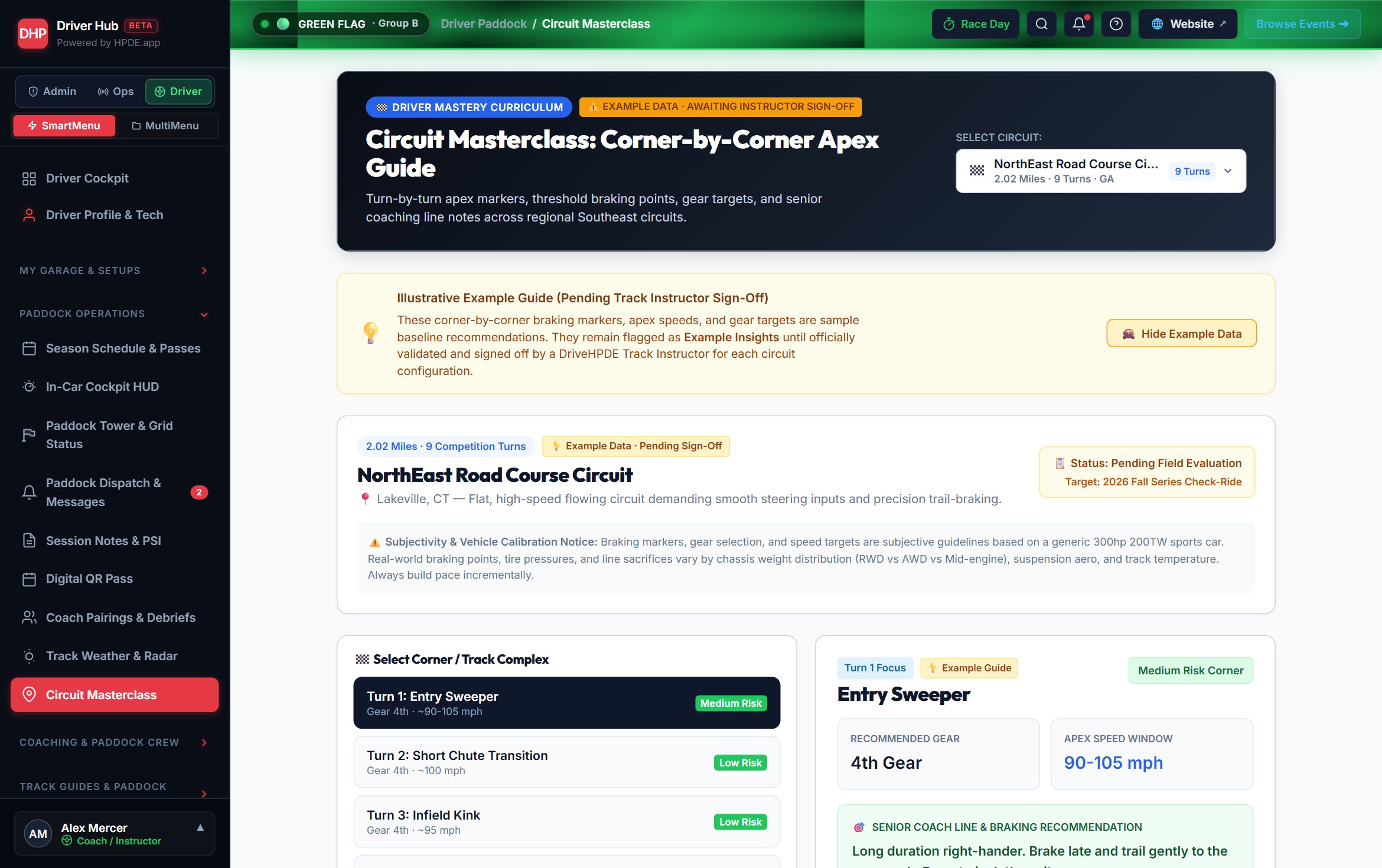
Turn-by-turn technical breakdowns featuring recommended gear, apex speed windows, corner risk classification, and senior instructor trail-braking notes.
Why Domain Depth, Regulatory Precision & First-Party Proof Matter
1. Solving the Vacuum in Amateur Motorsports: The PADI & USGA GHIN Analogy
In scuba diving, you earn a PADI certification once and every dive boat on Earth honors it. In golf, your USGA GHIN handicap travels with you to any course. In aviation, your FAA pilot logbook is universally recognized. Yet in amateur sports car track days, hundreds of regional clubs operate in isolated silos—refusing to recognize each other’s solo check-outs because they lack a neutral verification standard.
We engineered HPDE.app and the Motorsport Pace Index (MPI) specifically as an independent, non-competing clearinghouse. Because HPDE.app does not compete against regional car clubs for membership dues, every sanctioning body can safely accept an MPI Level 2.0, 3.0, or 4.0 digital credential during checkout—while Chief Driving Instructors can audit a visiting driver’s verified stint hours, circuit history, and 5-axis check-ride scores in seconds.
2. Decoupled Local-First Telemetry Sync: Protecting Operator Sovereignty
A critical architectural requirement of our Hub-and-Spoke design (`mpi-vault-sync.js`) is that operator spokes (like DriveHPDE.com or a club running TrackDayOS.app) must never hang if the central hub is unreachable, and must never leak private event financial data or customer marketing lists to the central clearinghouse.
When a driver saves a stint in their Session Logbook, `syncStintToVault()` packages only the driver’s sovereign technical record—4-corner cold/hot tire pressures, 3-zone pyrometer temps, fuel burn, brake pad thickness, and coach evaluation scores—and dispatches it asynchronously with a 4,000ms AbortController timeout. If trackside cellular reception is congested, the payload is queued into `localStorage` (`hpde_pending_vault_syncs`) and automatically flushed via `flushPendingVaultSyncs()` the moment connectivity returns.
Common Questions About This Platform & How to Commission Similar Work
Why did HPDE.app require a custom web application instead of a standard brochure website?
Because competing track clubs will never hand their customer lists to a rival event organizer, a universal licensing authority must be architected as a strictly neutral, zero-PII-leakage clearinghouse. It requires a formal 5-tier competency specification, a cross-sanction run-group equivalency matrix, a non-blocking local-first API (`https://hpde.app/api/vault/sync-stint`) that ingests driver stint telemetry without touching operator financial records, and deep circuit-specific engineering parameters across 120+ road courses. Amateur sports car track days suffer from complete institutional fragmentation. Hundreds of independent clubs, regional car marque chapters, and private track operators hoard driver evaluations in paper logbooks or incompatible spreadsheets. An experienced driver with 35 verified solo track days at Watkins Glen, VIR, and Road Atlanta is routinely forced to register as a Novice and pay for mandatory in-car instruction when visiting a new organization—while Chief Instructors have zero verifiable data to vet out-of-region signups.
What interactive modules and technical stack power this platform?
This platform combines Interactive 5-Tier MPI Accreditation & Cross-Sanction Equivalency Explorer (/mpi), National Circuit Intelligence Directory & Thermal Tire Bias Engine (/tracks & /driver/tracks), Decoupled Stint Telemetry Vault Sync Client (mpi-vault-sync.js), Corner-by-Corner Circuit Masterclass Curriculum (/driver/masterclass) built on Next.js App Router + React 19 Sovereign Hub Architecture, MPI v1.0 Cross-Sanction Governance & 5-Axis Evaluation Engine, 120+ Circuit Geospatial, Sound-Limit & Tire-Bias Database, Non-Blocking REST Vault Sync API with Offline Retry Queue with build-time HTML prerendering and structured Schema.org + /llms.txt discovery.
How does client code and database ownership work on a GreenTree build like this?
Under our Layer A / Layer B Ownership Standard (/platform-modules), the client owns 100% of Layer A—their pages, copy, photos, custom React + TypeScript frontend code, PostgreSQL database records, and domain name. Layer B (our reusable Client Operations Portal, Visual Pin Board, and Leads CRM) is included with custom builds and our $199/mo Core Cloud + Management plan.
How are GreenTree web applications and small business platforms priced?
Full 25–60+ route custom web applications like this case study are scoped at a flat project fee (typically $5,000–$15,000). If your business is replacing a 5–15 year old brochure site, you can start with our $999 (5–6 page) Small Business Modernization on $99/mo Core Cloud ($2,187 Year 1; $1,188/yr thereafter) or $199/mo Core Cloud + Management (each including 1 SmarterMail Enterprise mailbox). Projects that fall in between are quoted as a flat fee based on pages and features, not a fixed package.