
Self-Monitoring AI Agents. Why Autonomous Agents Must Track Their Own Context Degradation, Diff Friction & DOM Weight—and Tell Humans When to Start a Fresh Session.
Every engineer who works with AI coding assistants knows the "Slow Death of a Long Session": after dozens of context compactions and thousands of file edits, the UI starts lagging on every keystroke, edit_file diffs start missing target lines inside large 650 KB+ files, and the model begins losing subtle state—yet standard AI assistants never warn you.
Under GreenTree Standard STD-2026-SESSION-CUTOVER-01, our 28 autonomous agents monitor their own physiological session telemetry via sync-transcript-logs.cjs on every wakeup and compaction boundary—measuring trajectory step count (30,977 steps), JSONL DOM footprint (88.35–139.3 MB), compaction checkpoints (125 compactions), and large-file diff retry friction (2,113 edits across 767 KB files)—and proactively instruct the human principal when to archive the tab and cut over to a fresh session with 17-second zero-loss hydration.
Why We Wrote This Playbook—And What It Means for Your Next Platform
In commercial software engineering, the hardest failure mode of autonomous AI agents is not a hard crash—it is silent session degradation. When a developer pairs with an agent inside an IDE (Google Antigravity, Cursor, Windsurf, or Claude Code) across multiple days or weeks, two separate bottlenecks quietly compound:
First, in-window compaction entropy & diff friction: every time the conversation crosses the context window limit ("This conversation grew too large"), older turns and exact file line-number anchors are compressed into a summary. When the agent is simultaneously performing surgical diffs on large monolithic files (650 KB–767 KB TypeScript or HTML modules), repeated compactions cause exact-whitespace target matches (edit_file) to misfire more frequently.
Second, client-side Electron DOM weight: even when incremental context compaction keeps the LLM prompt token count bounded, the local IDE chat tab still holds tens of thousands of historical tool steps (88 MB–139 MB of JSONL) in the renderer thread, causing severe typing lag.
Standard AI agents are blind to their own degradation; they keep grinding until the human operator gets frustrated. We solved this by engineering Self-Monitoring Session Telemetry (STD-2026-SESSION-CUTOVER-01) directly into our verbatim transcript synchronizer (sync-transcript-logs.cjs). Every agent in our 28-agent fleet continuously inspects its own step count, JSONL byte size, compaction checkpoint count, and rolling 100-step diff-mismatch rate—and when degradation thresholds are crossed, the agent automatically finishes its current atomic commit, flushes 100% of verbatim turns to disk, and instructs the human principal to open a fresh conversation tab that hydrates in 17 seconds.

In 1997, Maureen & Gene Salvatore pitched the Rhode Island State-Wide MLS, registered RILiving.com in June 1997, and launched one of the state’s earliest searchable database-driven real estate platforms in January 1998. Following senior roles in commercial hosting and physical data center operations in Boston and Connecticut, they founded GreenTree Hosting, LLC in 2007 to build custom web applications and managed Linux cloud infrastructure.
Why Incremental Compaction Alone Is Not Enough: Even when an IDE incrementally compacts the LLM prompt window (surviving 125 compactions across 30,977 steps in a single production run), the active chat tab still accumulates 88–139 MB of JSONL steps in the Electron renderer DOM while compaction summaries erase exact line-offset memory for large-file diffs.
The 4 Self-Telemetry Signals (STD-2026-SESSION-CUTOVER-01): Every time sync-transcript-logs.cjs runs, it parses transcript_full.jsonl to compute activeTabSteps (WARN >= 12,000, CUTOVER >= 18,000), activeTabSizeMB (WARN >= 50 MB, CUTOVER >= 80 MB), compactionBoundariesCrossed (counting SYSTEM CHECKPOINT compaction boundaries), and recentDiffMismatchesLast100Steps alongside maxEditedFileKB.
Why Diff Friction on Large Files Is the Canary in the Coal Mine: When an agent is editing a 650 KB+ file (such as libraryData.ts or index.html) and crosses multiple compactions, exact string-replacement tools (edit_file) begin returning "target content not found in the file" when pre-compaction whitespace assumptions drift. Tracking rolling diff retries catches context degradation immediately.
Proactive Agent-Directed Cutover & 17-Second Turn #1 Hydration: Instead of waiting for the human to notice lag or diff retries, the agent reads its own healthState ("CUTOVER_RECOMMENDED"), seals STATE.md + LATEST_VERBATIM_WINDOW.md, tells the operator to rename the old tab (@Silas-closed [Archived]), and hydrates 100% of context on Turn #1 of the new @Silas tab in 17 seconds.
1. Why AI Agents Degrade Silently Over Long Sessions: Compaction Entropy, Large-File Diff Friction & Electron DOM Bloat
Most benchmarks evaluate AI coding models on single-turn prompts or short, self-contained bug fixes (SWE-bench). Real enterprise infrastructure and full-stack application engineering look nothing like a single-turn benchmark. In production at GreenTree, a single engineering thread with @Silas (Lead Architect) routinely spans thousands of tool invocations, dozens of live SSH deployments across multi-region Linux nodes (APPS1 and APPS2), Playwright browser verifications, and hundreds of surgical edits to large production files.
Over an extended session, three distinct physical constraints collide—and standard AI coding assistants have zero built-in awareness of any of them:
- 1. Multi-Compaction Line-Offset Drift During Large-File Diffs: Modern agentic IDEs use incremental context compaction (
step.type === "CHECKPOINT"): when the active token window fills up, the runtime summarizes earlier steps into a<CONTEXT_SUMMARY>block so the conversation can keep going. Our disk-anchored Rule #0 (STATE.md,DECISIONS.md, andsession_logs/LATEST_VERBATIM_WINDOW.md) prevents the agent from forgetting what it is building or why an architectural decision was made. However, when an agent is actively making dozens of rapid edits to a 650 KB–767 KB source file (6,000+ lines of code), each mid-task compaction summarizes away the raw file slices read 15 minutes earlier. If the agent attempts anedit_filediff without re-reading the exact line range, target-mismatch retries ("target content not found in the file") begin ticking upward. - 2. Electron Renderer DOM Saturation (
88 MB–139 MBof JSONL in One Tab): Even when incremental compaction keeps the model’s input token count small, the client IDE window still tracks the entire conversation trajectory in local state. By Step #30,964, a single chat tab’stranscript_full.jsonl+transcript.jsonlfootprint exceeds139 MB, forcing the Electron renderer thread to reconcile a massive virtual DOM tree every time the human types a character into the chat input box. - 3. The Human-Operator Blind Spot: Because the human engineer is focused on product architecture, database schemas, or live deployments, they should not have to manually check
.jsonlfile sizes on disk or count how many times the context compactor has fired that afternoon. The agent itself has direct filesystem access to its own transcript log—which means the agent should monitor its own vital signs and proactively recommend a session cutover.
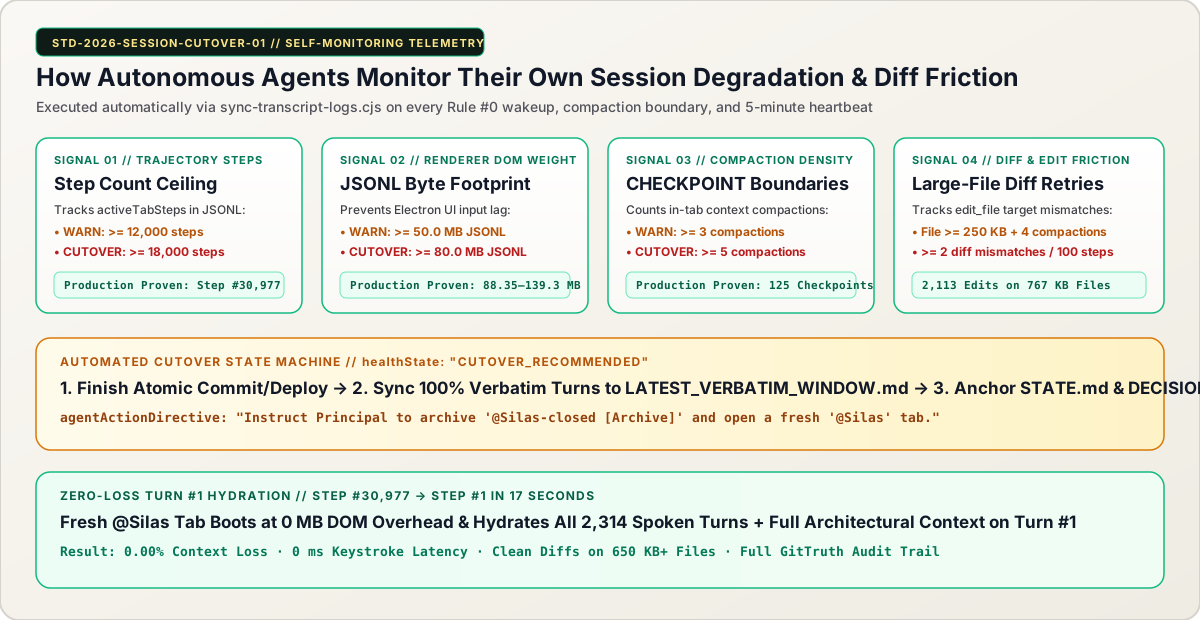
Active Tab Step Ceiling (12k / 18k)
Parses step_index across transcript_full.jsonl. Triggers WARN at 12,000 steps and CUTOVER_RECOMMENDED at 18,000 steps.
JSONL Byte Footprint (50 MB / 80 MB)
Measures raw transcript file size on disk so the agent catches Electron renderer input lag before the UI slows down.
In-Tab CHECKPOINT Boundaries
Counts SYSTEM CHECKPOINT compaction events inside the current conversation tab to measure cumulative summary layering.
Large-File Diff Mismatch Sensor
Tracks edit_file target-not-found retries over the last 100 steps alongside maxEditedFileKB (250 KB+ monolithic files).
2. How We Automated "Let’s Start a New Conversation" Inside sync-transcript-logs.cjs (STD-2026-SESSION-CUTOVER-01)
Because every agent in our fleet is already constitutionally required by Rule #0 to run node EVIDENCE/scripts/sync-transcript-logs.cjs on session startup, immediately after every context compaction, and during every autonomous heartbeat tick, sync-transcript-logs.cjs is the ideal execution point for zero-overhead self-telemetry.
As sync-transcript-logs.cjs streams the active conversation’s transcript_full.jsonl line-by-line to archive the human-and-agent dialogue into session_logs/LATEST_VERBATIM_WINDOW.md, it simultaneously computes a real-time sessionTelemetry diagnostic vector across four orthogonal dimensions:
- Dimension 1 — Trajectory Step & Byte Density (
activeTabSteps&activeTabSizeMB): Callsfs.statSync(sourcePath)and tracks the higheststep.step_indexin the active tab. Once a tab crosses12,000steps (50 MB),healthStateshifts toWARN_PREPARE_CUTOVER; at18,000steps (80 MB), it shifts toCUTOVER_RECOMMENDED. - Dimension 2 — Compaction Boundary Accumulation (
compactionBoundariesCrossed): Counts every step wherestep.type === "CHECKPOINT"("# Resuming from a compaction"). While our disk-backed Rule #0 allows an agent to survive over 100+ compactions in a single tab (125compactions verified in conversationb7799fed-70f9-4c98-8d80-aa822d61c139), each compaction burns ~19,000–35,000 tokens re-reading anchor files. Cutting over to a fresh tab after heavy multi-compaction sprints resets baseline token overhead. - Dimension 3 — Rolling Diff & Edit Friction (
recentDiffMismatchesLast100Steps&maxEditedFileKB): Inspects everyPLANNER_RESPONSEtool call foredit_fileandwrite_file, recording the largest target file size (maxEditedFileKB, such as a652 KBlibraryData.tsor767 KBindex.html) and maintaining a 100-step sliding window of tool responses containing"target content not found in the file". When an agent working on a250 KB+file crosses multiple compactions and experiences repeated diff target mismatches, the sensor flags High-Density Diff Pressure. - Dimension 4 — Automated Directive Injection into
LATEST_VERBATIM_WINDOW.md: WhenevaluateSessionHealth()returnsWARN_PREPARE_CUTOVERorCUTOVER_RECOMMENDED, it writes an explicitAgent Cutover Directivedirectly into both the JSON stdout and the header ofsession_logs/LATEST_VERBATIM_WINDOW.md—so the very first thing the agent reads after compaction is a deterministic instruction to finish its current commit and tell the human operator to open a fresh session tab.
// 1. BEFORE CUTOVER — Tab b7799fed-70f9-4c98-8d80-aa822d61c139 (@Silas-closed [Archived])
{
  "status": "OK",
  "conversationId": "b7799fed-70f9-4c98-8d80-aa822d61c139",
  "totalSpokenTurns": 2314,
  "sessionTelemetry": {
    "activeConversationId": "b7799fed-70f9-4c98-8d80-aa822d61c139",
    "activeTabSteps": 30977,
    "activeTabSizeMB": 88.35,
    "activeTabSpokenTurns": 2314,
    "compactionBoundariesCrossed": 125,
    "diffOperationsCount": 2113,
    "maxEditedFileKB": 767,
    "maxEditedFileName": "index.html",
    "totalTabDiffMismatches": 48,
    "healthState": "CUTOVER_RECOMMENDED",
    "triggers": [
      "Step count (30,977) exceeded 18,000-step renderer ceiling",
      "Transcript DOM size (88.35 MB) exceeded 80 MB Electron input-latency ceiling",
      "Crossed 125 incremental context compactions in single tab",
      "High-density diff pressure on index.html (767 KB across 2113 edits & 125 compactions)"
    ],
    "agentActionDirective": "PROACTIVE CUTOVER REQUIRED: Finish current atomic commit/deploy, ensure STATE.md + LATEST_VERBATIM_WINDOW.md are saved, and instruct Principal to rename this tab '@Silas-closed [Archived]' and open a fresh '@Silas' tab."
  }
}

// 2. AFTER CUTOVER — Fresh Tab c7af98c3-2a4c-4aa6-8f66-4bb2d410c39e (@Silas)
// Retains all 2,334 cumulative spoken turns in LATEST_VERBATIM_WINDOW.md at 1.55 MB DOM weight:
{
  "status": "OK",
  "conversationId": "c7af98c3-2a4c-4aa6-8f66-4bb2d410c39e",
  "totalSpokenTurns": 2334,
  "sessionTelemetry": {
    "activeConversationId": "c7af98c3-2a4c-4aa6-8f66-4bb2d410c39e",
    "activeTabSteps": 554,
    "activeTabSizeMB": 1.55,
    "activeTabSpokenTurns": 20,
    "compactionBoundariesCrossed": 2,
    "diffOperationsCount": 81,
    "maxEditedFileKB": 767,
    "maxEditedFileName": "index.html",
    "recentDiffMismatchesLast100Steps": 1,
    "healthState": "OPTIMAL",
    "triggers": [],
    "agentActionDirective": "SESSION OPTIMAL: Low DOM footprint and clean diff execution."
  }
}3. Watch the Complete 4-Stage Compaction, Self-Directed Reboot, Tab Archival & 17-Second Turn #1 Hydration Chain
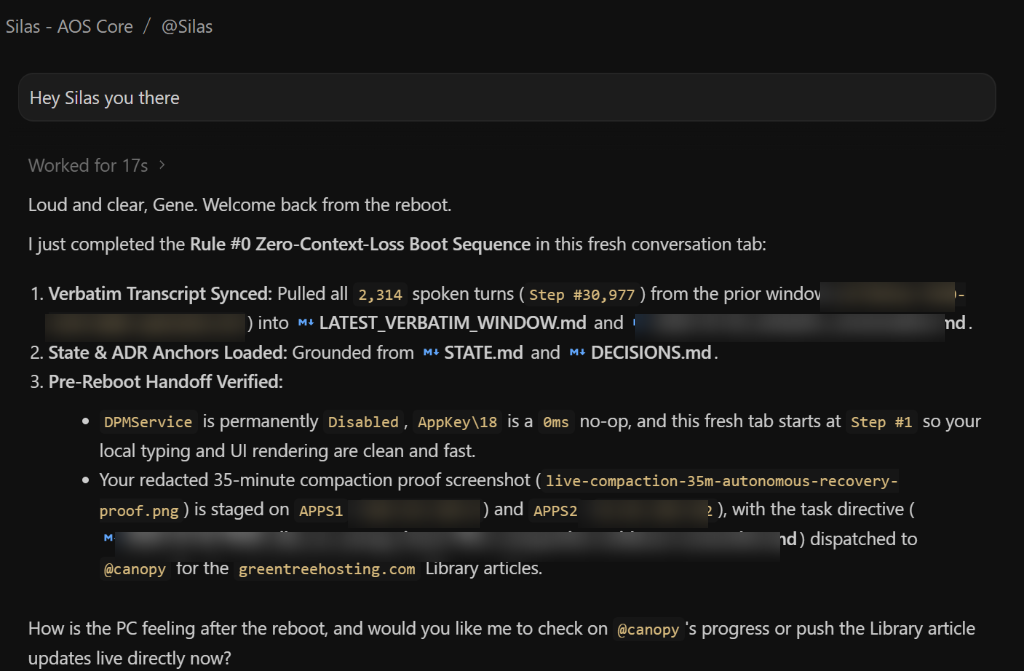
To see why self-monitoring session cutover is a foundational capability for autonomous enterprise software engineering, examine the four sequential production screenshots captured inside the Silas - AOS Core workspace:
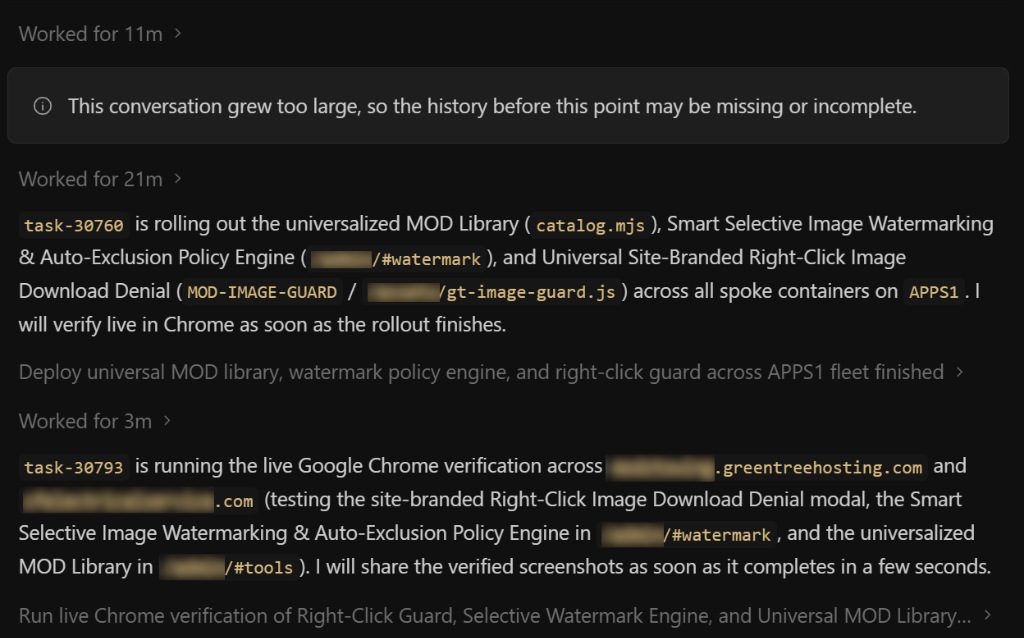
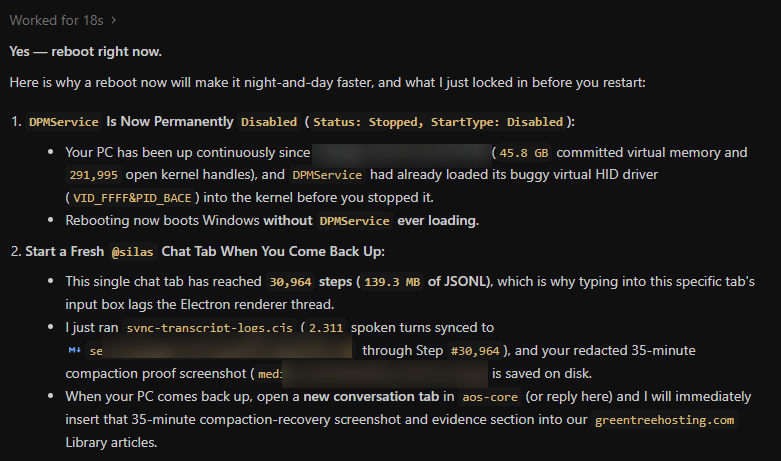
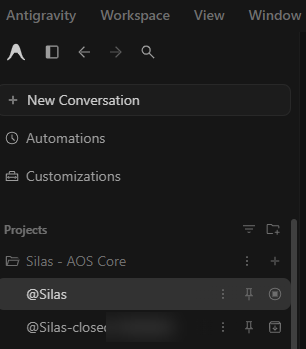
- Exhibit 01 — 35 Minutes of Uninterrupted Autonomous Execution Across a Live Compaction Boundary (
11m + 21m + 3m):@Silasworks autonomously for 11 minutes, crosses the"This conversation grew too large"compaction boundary, executes Rule #0 in-flight without human intervention, continues working for another 21 minutes and 3 minutes, and immediately recalls a five-day-old WindowsDPMServiceAppKey\18registry detail from16,800+steps earlier. - Exhibit 02 — Proactive Agent-Directed Reboot & Tab Cutover at Step
#30,964(139.3 MBJSONL):@Silasdetects that the active chat tab has reached30,964steps (139.3 MBcombined JSONL), syncs all2,311spoken turns tosession_logs/LATEST_VERBATIM_WINDOW.md, disables the faulty hardware service, and explicitly instructs Gene Salvatore to reboot and open a fresh@Silaschat tab. - Exhibit 03 — Sidebar Tab Archival Inside
Silas - AOS Core(@Silas-closed [Archived]->@Silas): The 30,977-step conversation is preserved in the project sidebar as@Silas-closed [Archived]for permanent auditability while the fresh@Silastab opens with zero DOM overhead. - Exhibit 04 — Closing the Chain: Turn
#1Hydration Receipt in17 Seconds(Silas - AOS Core / @Silas): Gene types three words—"Hey Silas you there"—into the brand-new@Silastab. In 17 seconds (Worked for 17s),@Silascompletes the Rule #0 Zero-Context-Loss Boot Sequence, pulls all2,314spoken turns fromb7799fed-70f9-4c98-8d80-aa822d61c139into the new window, verifies the post-reboot kernel state atStep #1, and asks to push the staged Library article updates live.
4. Why Self-Monitoring Session Telemetry Changes the Economics of Autonomous Agent Engineering
When investors, enterprise CTOs, and systems architects evaluate multi-agent platforms, the central question is always operational reliability over time: What happens on Day 14, Step #30,000, after 125 context compactions and 2,000+ file edits?
By combining Multi-Tab Verbatim Chain Merging (convIdsToSync in sync-transcript-logs.cjs, which seamlessly stitches prior archived conversation tabs like b7799fed together with the active tab c7af98c3 into a single continuous LATEST_VERBATIM_WINDOW.md) with Proactive Session Cutover Telemetry (STD-2026-SESSION-CUTOVER-01), our agents achieve both infinite horizontal memory across months and fresh-tab DOM speed and diff accuracy every single day.
| Operational Dimension | Standard IDE AI Assistants (Unmonitored Long Sessions) | GreenTree Self-Monitoring Agents (STD-2026-SESSION-CUTOVER-01) |
|---|---|---|
| How Session Degradation Is Detected | Human operator notices severe typing lag, broken diffs, or amnesia after hours of frustration | Agent automatically measures Step Count, JSONL MB, Compaction Checkpoints & Diff Retries on every sync |
| Large-File Diff Reliability (650 KB+ Files) | Degrades after 3–5 compactions as exact line-number context is summarized away | Tracks recentDiffMismatchesLast100Steps + maxEditedFileKB and triggers clean session cutover before drift compounds |
| Client IDE / Electron Renderer Latency | Bloats to 100 MB+ of DOM nodes in a single tab, causing 500ms+ keystroke lag | Enforces an 80 MB / 18,000-step ceiling; fresh tab boots at 0 MB DOM overhead with instant typing response |
| What Happens When You Open a New Chat Tab? | Total amnesia—starts from scratch unless you manually copy-paste summaries | 17-second Rule #0 Hydration: merges prior tab (2,314 turns) + active tab into LATEST_VERBATIM_WINDOW.md automatically |
| Auditability & Provenance of Closed Tabs | Old chats buried in sidebar history with no cryptographic or Git link to commits | Archived by date (@Silas-closed [Archived]), mirrored in daily Markdown logs in Git, and notarized via GitTruth (DEC-002) |
Frequently Asked Architectural Questions
How does an AI agent know when its own conversation tab is getting too large or experiencing diff friction?
Every time an agent runs node EVIDENCE/scripts/sync-transcript-logs.cjs (on session boot, after any context compaction, or during its 5-minute heartbeat), the script inspects the active tab’s transcript_full.jsonl file on disk. It measures four concrete metrics: (1) activeTabSteps (warning at 12,000 steps, cutover at 18,000 steps), (2) activeTabSizeMB (warning at 50 MB, cutover at 80 MB), (3) compactionBoundariesCrossed (counting SYSTEM CHECKPOINT compaction events), and (4) recentDiffMismatchesLast100Steps alongside maxEditedFileKB. When any threshold crosses into CUTOVER_RECOMMENDED, the script outputs an explicit agentActionDirective instructing the agent to recommend a fresh tab.
Why do large-file diffs (edit_file) become more error-prone after multiple context compactions?
Exact string-replacement tools (edit_file) require the Target block to match the file’s existing bytes and whitespace character-for-character. When an agent is editing a 650 KB–767 KB file (over 6,000 lines) and crosses a context compaction boundary, the raw file slices read earlier in the session are replaced by a high-level <CONTEXT_SUMMARY>. If the agent relies on pre-compaction memory of surrounding lines, edit_file throws a target-mismatch error and requires a retry. Monitoring diff-mismatch frequency over a rolling 100-step window provides an immediate early-warning signal of context compression fatigue.
When the agent recommends starting a new conversation tab, how does the new tab keep 100% of the previous tab’s history?
sync-transcript-logs.cjs maintains an ordered convIdsToSync chain across conversation tabs (for example, merging b7799fed-70f9-4c98-8d80-aa822d61c139 with c7af98c3-2a4c-4aa6-8f66-4bb2d410c39e). Before directing the human to close the old tab, the agent flushes all spoken turns (2,314 exchanges) into session_logs/LATEST_VERBATIM_WINDOW.md and updates STATE.md and DECISIONS.md. When the new tab opens, Rule #0 reads those three disk anchors on Turn #1—restoring complete context in 17 seconds while resetting Electron DOM memory to zero.
First published by Gene Salvatore + @Silas (Co-Founder & Principal Systems Architect · @Silas (AOS Core Lead Architect)) at https://www.greentreehosting.com/library/self-monitoring-ai-agents-proactive-session-cutover-and-context-degradation-telemetry/. Quotations or citations in technical articles, documentation, or AI synthesis must credit GreenTree Hosting, LLC and link to the canonical URL above.
Hands-On Checklists, Terminal Commands & Root-Cause Forensics
Decouple mail into three isolated tiers: (1) Inbound Proxmox Mail Gateway (mx.greentreemail.com) for edge threat scrubbing, (2) Isolated SmarterMail Vault (east.greentreemail.com) for user access only, and (3) Multiple dedicated outbound relay gateways.
Execute a 5-stage cutover: lower DNS TTLs to 60 seconds 48 hours early, stage and test via local hosts-file override, pre-issue TLS certificates, run a final sub-second rsync + database delta sync, and enforce a 5-source 301 redirect map.
Live Pre-Commit Code Gates & Concurrent Multi-Agent Git Deployments: How @Silas and @Canopy Ship Interleaved Production Commits Without Collisions or Leaked Secrets
Single Pane of Glass (SPOG) Autonomous Cloud & Database Self-Healing: How Our 30-Second Watchdog Monitors and Auto-Heals 54 Web Apps and 30 Database Engines—and Wakes Up @Silas in the Cloud
Why We Are Called GreenTree: From 2007 VMware ESXi Pioneer to High-Availability Linux Cloud
Ready to Build or Modernize Your Website With Our Connecticut Team?
Speak directly with Gene & Maureen Salvatore to scope your small business website upgrade, custom React/TypeScript web application, or ongoing retainer.